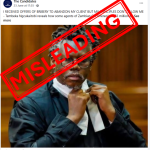
Claims that President Hakainde Hichilema ordered the closure of courts to block a presidential election petition are misleading. Official statements attribute the temporary restrictions to security operations, and a presidential petition was subsequently filed and referred by the Chief Justice to the Constitutional Court despite questions over its mode of submission.
Claim
On Monday, 24 August 2026, the Emmanuel Mwamba Facebook page published a post captioned “Post electoral crisis in Zambia.”
The post claimed that: “On Monday, 24th August 2026, the last day to file this petition, President Hichilema ordered the closure of all courts in Zambia to prevent the presidential petition from being filed.”
Similar claims circulated widely across social media, alleging that President Hakainde Hichilema ordered the closure of courts nationwide to prevent his closest challenger in the 13 August 2026 General Election, Brian Mundubile, from filing a presidential election petition.
Verdict: Misleading
Rating Justification
iVerify Zambia conducted a fact-check and found the claim to be misleading.
The allegation that President Hakainde Hichilema personally ordered the closure of courts across Zambia to prevent the filing of a presidential election petition is not supported by any credible evidence.
An official statement issued by the State House Chief Communications Specialist, Clayson Hamasaka, explained that the temporary restrictions implemented on Monday, 24 August 2026 were security measures based on intelligence assessments. According to the statement, the measures were not limited to the Judiciary but also affected several other key government institutions, including those under the Ministry of Justice, the Ministry of Home Affairs and Internal Security, the National Prosecution Authority, and the Attorney General’s Chambers.
Mr. Hamasaka dismissed claims that the President had directed the closure of courts as inconsistent with the constitutional order and unsupported by the facts.
Similarly, Inspector General of Police Graphel Musamba stated that the security operation was intelligence-led and preventive in nature. He explained that it was intended to safeguard government institutions, public officers, and members of the public by identifying and addressing potential security threats and vulnerabilities.
Importantly, available information also shows that the security measures did not prevent the filing of a presidential election petition altogether. Although concerns were raised about access to court premises, some petitioners were able to submit a petition, albeit through a mode of submission that has been described as irregular. The Chief Justice subsequently referred the matter to the Constitutional Court, where issues relating to the petition, including its manner of filing and admissibility, can be determined in accordance with the law.
These developments contradict the claim that the courts were completely closed to ensure that no petition could be filed.
Conclusion
The claim that President Hakainde Hichilema ordered the closure of courts across Zambia to prevent Brian Mundubile or other petitioners from filing a presidential election petition is misleading. iVerify Zambia found no credible evidence linking the President to such an order. Official statements from State House and the Zambia Police indicate that the restrictions formed part of a broader security operation affecting multiple government institutions, not just the Judiciary.
Furthermore, despite the reported disruptions, a presidential petition was in fact filed and has since been referred by the Chief Justice to the Constitutional Court, demonstrating that the judicial process has continued, even as questions surrounding the petition’s mode of submission remain for the Court to determine.
Given the political sensitivity of the post-election period, claims alleging interference with the Judiciary or denial of access to justice should be carefully verified before being shared. Unsubstantiated allegations can undermine public confidence in democratic institutions and unnecessarily heighten political tensions.