Two social media posts falsely claim that the United Nations (UN) and SADC confirmed Brian Mundubile’s victory in Zambia’s 2026 General Election, using an unverified PVT graphic and a fabricated congratulatory message. Neither organisation confirmed the purported results or congratulated Mundubile, and the posts falsely attribute unverified election information to the UN and SADC.
Claim
Two social media posts falsely suggest that the United Nations (UN) had confirmed or endorsed opposition candidate Brian Mundubile’s victory in Zambia’s 2026 General Election.
The first, shared by the Chair the Voice of Zambia Facebook page and other social media platforms, features a purported Parallel Vote Tabulation (PVT) graphic showing Mundubile (BM8) leading incumbent President Hakainde Hichilema (HH) with 51.10% of the national vote. The graphic bears the logos of the United Nations (UN) and the Southern African Development Community (SADC), creating the impression that the figures were endorsed by the two organisations.
A second post, published on the Africa Media Channel Facebook page, claims that UN election observers had congratulated Brian Mundubile on winning the election before the Electoral Commission of Zambia (ECZ) announced the official results. The post attracted more than 350 reactions and was shared more than 70 times.
Note: The links to the two posts containing fake content have been removed in line with iVerify policy to avoid spreading misinformation.
Verdict: False
Rating Justification
The posts are false and promote the same misleading narrative by portraying unverified election information as having been endorsed by the United Nations.
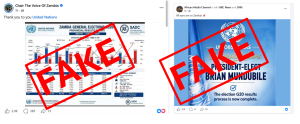 One post shares a purported Parallel Vote Tabulation (PVT) graphic claiming Brian Mundubile had secured 51.10% of the vote before the Electoral Commission of Zambia (ECZ) had announced the official presidential results. Under Zambian law, only the ECZ is authorised to declare official election results, making the figures unverified. The graphic also displays the logos of the United Nations (UN) and the Southern African Development Community (SADC), falsely suggesting institutional endorsement. A review of the official websites and social media channels of both organisations found no statement confirming election results or congratulating any candidate. Likewise, no UN election observer mission issued a press release or briefing declaring a winner.
While Parallel Vote Tabulation (PVT) is a recognised election observation methodology, its findings are not official election results and cannot replace the ECZ’s declaration. Falsely attributing election results or statements to international organisations such as the UN or SADC is particularly harmful because it can mislead the public, undermine confidence in the electoral process, and heighten political tensions.
Therefore, both the purported PVT graphic and the alleged UN congratulatory message falsely imply that the United Nations endorsed an election outcome that had not been officially declared.
Conclusion
The circulating posts falsely attribute unverified election figures and a congratulatory message to the United Nations. Neither the UN nor SADC confirmed the purported PVT results or congratulated any presidential candidate. The only institution legally authorised to declare Zambia’s official election results is the Electoral Commission of Zambia. Until the ECZ announces the final results, any graphics or statements claiming a confirmed winner should be treated as unverified.
Help Stop the Spread of Misinformation
Before sharing election-related content, verify whether it comes from credible and official sources. If you encounter suspicious claims, images, or videos, submit them to iVerify Zambia for verification.
📧 Email: factcheck@panos.org.zm
📱 WhatsApp: +260 762 974 750
Together, we can reduce the spread of misinformation and disinformation, promote access to accurate and verified information, and help protect the integrity of public discourse.