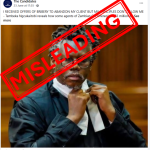
Claim
A number of publications by a page associated with Mr. Emmanuel Jay Banda, the former Petauke Central Member of Parliament, have been circulating, alleging that the Special Assistant to the President for Legal Affairs, Mr. Christopher Mundia had written letters directing various institutions, including Parliament and the Electoral Commission. In one such “letter”, Mr Mundia purportedly wrote to Hon. Nelly Butete Kashumba Mutti, SC, Speaker of the National Assembly of Zambia, directing her to reserve rulings concerning the status of certain Members of Parliament. Mr. Banda also claims Mr. Mundia issued similar directives to Mr. Brown Kasaro, the Chief Electoral Officer of the Electoral Commission of Zambia, instructing him to grant access and support to five individuals alleged to be of Brazilian origin. The letter does not disclose what access and support was to be given to the “five gentlemen”, although it mentions a Voter Tabulation System. The publication, which surfaced on 6 May 2026, attracted significant public attention and generated widespread debate and diverse reactions on social media.
Verdict: False
The circulating letters claiming that the Presidential Legal Advisor issued directives to various institutions are false. There is no credible evidence that the Special Assistant to the President for Legal Affairs, Mr. Christopher Mundia, authored or issued the viral letters circulating online. The documents contain several inconsistencies, including the absence of official letterheads and stamps typically associated with authentic communication from the Office of the President. Mr. Mundia has also publicly refuted the claims and dismissed the letters as false.
Rating Justification
The iVerify Zambia Fact Checking and Response Mechanism has found the claims by Mr. Emmanuel Jay Banda to be false. The letters in question were neither written nor issued by the Special Assistant to the President for Legal Affairs, Mr. Christopher Mundia, as alleged. An analysis of the general presentation of the letters revealed several inconsistencies that do not align with the standard features of official correspondence from the Office of the President.
Notably, the letters are not written on the regular official letterhead and do not bear an official stamp, both of which are essential features of authentic communication from the President’s office. These irregularities strongly suggest that the letters are not genuine.
Furthermore, the Special Assistant to the President, Mr. Christopher Mundia, the alleged author of the many letters, publicly refuted the allegations through a post on his verified Facebook page, where he dismissed the circulating letters as false, and cautioned politicians against activities that mislead the public or spread misinformation. The findings, therefore, indicate that the circulating publications and accompanying letters are false and lack credible evidence to support the claims being made.
Conclusion
In conclusion, the circulation of such misleading publications highlights the damaging effects of disinformation on public trust and democratic processes. False claims not only mislead citizens but also risk undermining the credibility of public institutions and officials, while fueling unnecessary confusion, mistrust, and political polarization. It is therefore essential for both political actors and the public alike to prioritize accuracy, verify information before sharing it, and promote responsible communication to safeguard the integrity of public discourse and strengthen democratic accountability.